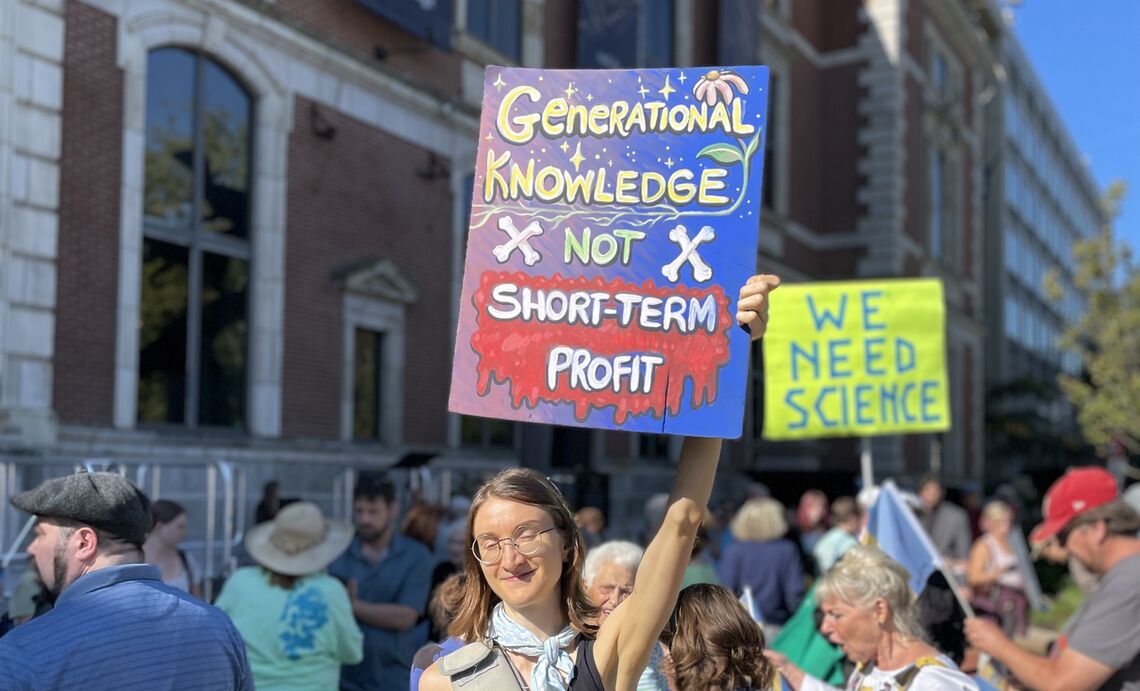
Update: Email Deputy Mayor Patricia "Trish" Wellenbach (tw958@drexel.edu) before October 1st and tell her why you love the Academy and why it must be saved. Then sign the PETITION. Learn more about other ways to get involved and SAVE THE ACADEMY.
The closure of the Academy of Natural Sciences is a devastating loss for Philadelphia and a stark warning about the state of the city's cultural institutions.
As the nation's oldest natural sciences museum, the Academy is far more than a destination on the Benjamin Franklin Parkway. For generations of Philadelphians, it has been a place of discovery, education, and engagement with the natural world, where countless children first encountered dinosaurs, wildlife, biodiversity, and the wonder of scientific exploration. Its collections, research, and educational programs have connected children, families, teachers, students, and researchers to scientific knowledge for more than two centuries. The Academy has helped shape how countless residents understand biodiversity, wildlife, ecology, and the natural environment, while serving as one of Philadelphia's most important educational and cultural assets.
The loss of such an institution would be troubling under any circumstances. It is even more alarming because it is not an isolated event.
The Academy's closure follows the abrupt and shocking collapse of the University of the Arts, the continued neglect and uncertainty surrounding the Atwater Kent Museum building, the closure of PAFA's Fine Arts degree programs, and the ongoing failure to establish a worthy Philadelphia history museum. A troubling pattern is no longer hard to see; Philadelphia is steadily weakening the institutions that educate, inspire, and help define its civic and cultural identity.
The city’s cultural sector is increasingly being asked to do more with less, even as expectations for its educational, civic, and economic contributions, and the overall city budget, continue to grow. The gap between the public value of these institutions and the public resources provided to sustain them can no longer be ignored.
Philadelphia's museums, libraries, performance venues, historic sites, and cultural organizations are among the city's defining assets. They attract visitors, support economic activity, strengthen neighborhoods, and contribute to quality of life. They help tell the story of Philadelphia and connect residents to something larger than themselves.
For more than two centuries, the Academy embodied that role.
Its closure is especially painful given the significant attention currently focused on the future of the Benjamin Franklin Parkway. Public agencies, cultural organizations, and civic leaders are investing enormous time and resources into envisioning the Parkway's next chapter. Yet any conversation about the future of the Parkway must begin with a simple reality: its success has always depended on the strength of its institutions.
Conceived as Philadelphia's grand cultural boulevard, the Parkway was not created to showcase sidewalks, lighting, or landscaping. It was created to connect some of the nation's greatest cultural and educational destinations. A revitalized Parkway without a thriving Academy of Natural Sciences is a diminished Parkway.
Cities across the country compete aggressively to attract and retain cultural institutions because they understand their value. They are not luxuries. They are long-term investments whose benefits extend far beyond their balance sheets. Philadelphia should be doing everything possible to strengthen institutions like the Academy, not standing by as they disappear.
Great institutions are easy to take for granted precisely because they feel permanent. In reality, they are fragile achievements that require sustained investment, leadership, and public support. That realization must force a broader conversation about cultural stewardship in Philadelphia. What institutions are essential to the city's future? What commitments are required to sustain them? And what role should government, philanthropy, educational institutions, and civic leaders play in ensuring their survival?
The Design Advocacy Group believes this outcome is unacceptable. Losses of this magnitude are not inevitable. They are the product of priorities, and priorities can, and must, change.
The Academy's closure did not occur overnight. Similar to other losses across Philadelphia's cultural landscape, it reflects years of deferred attention and underinvestment, and a widening disconnect between the public value of these organizations and the resources committed to sustaining them.
That trajectory must change. City leaders, philanthropic institutions, educational organizations, and the broader civic community must prioritize renewed investment before more of Philadelphia's cultural infrastructure is diminished beyond recovery. The cost of preserving these institutions is far less than the cost of replacing what they leave behind.
Once institutions like the Academy are lost, rebuilding what they provided is measured not in years, but in generations. Philadelphia cannot afford to keep learning that lesson.
The DAG Steering Committee